
Pipeline Protocol





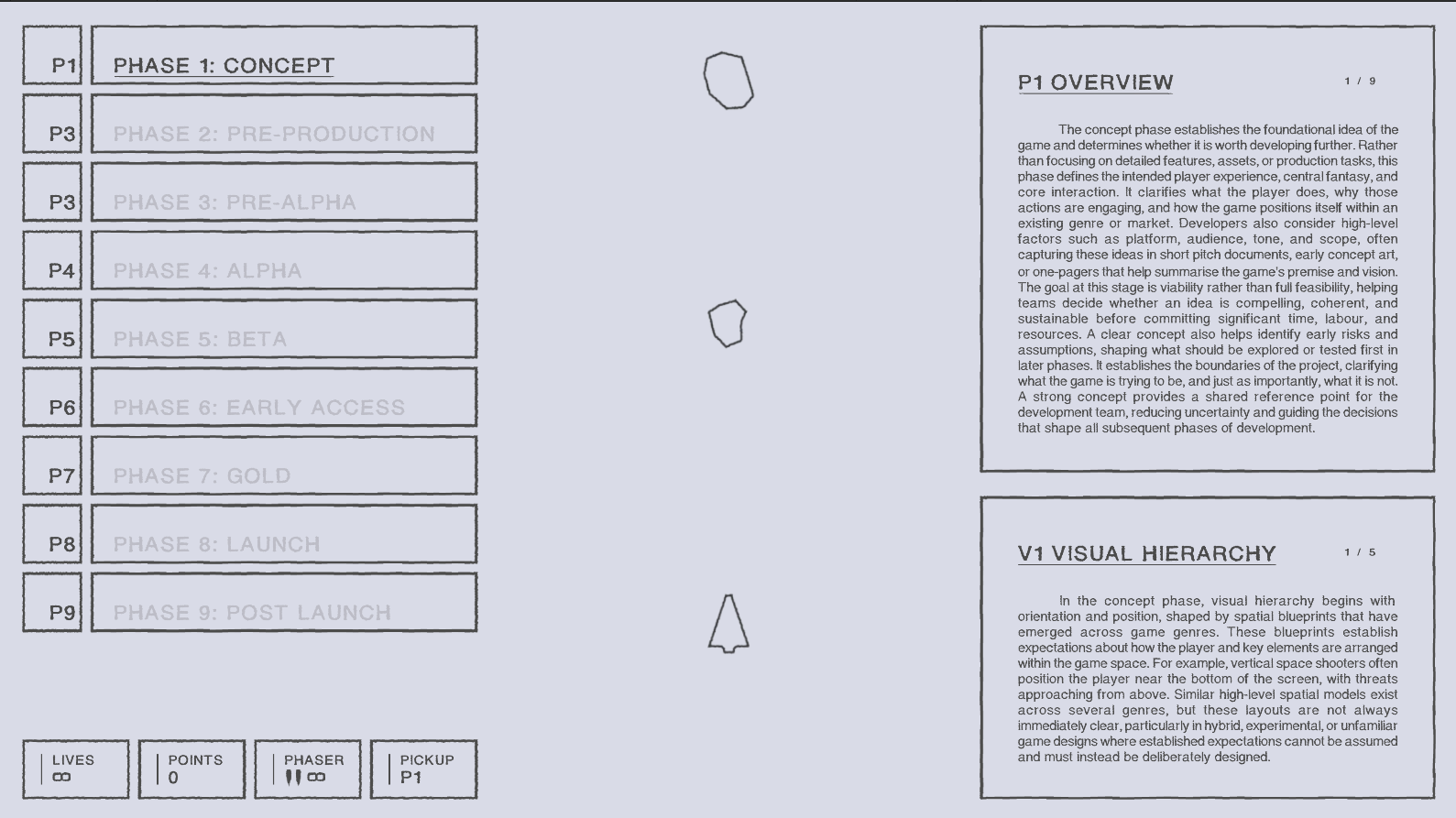
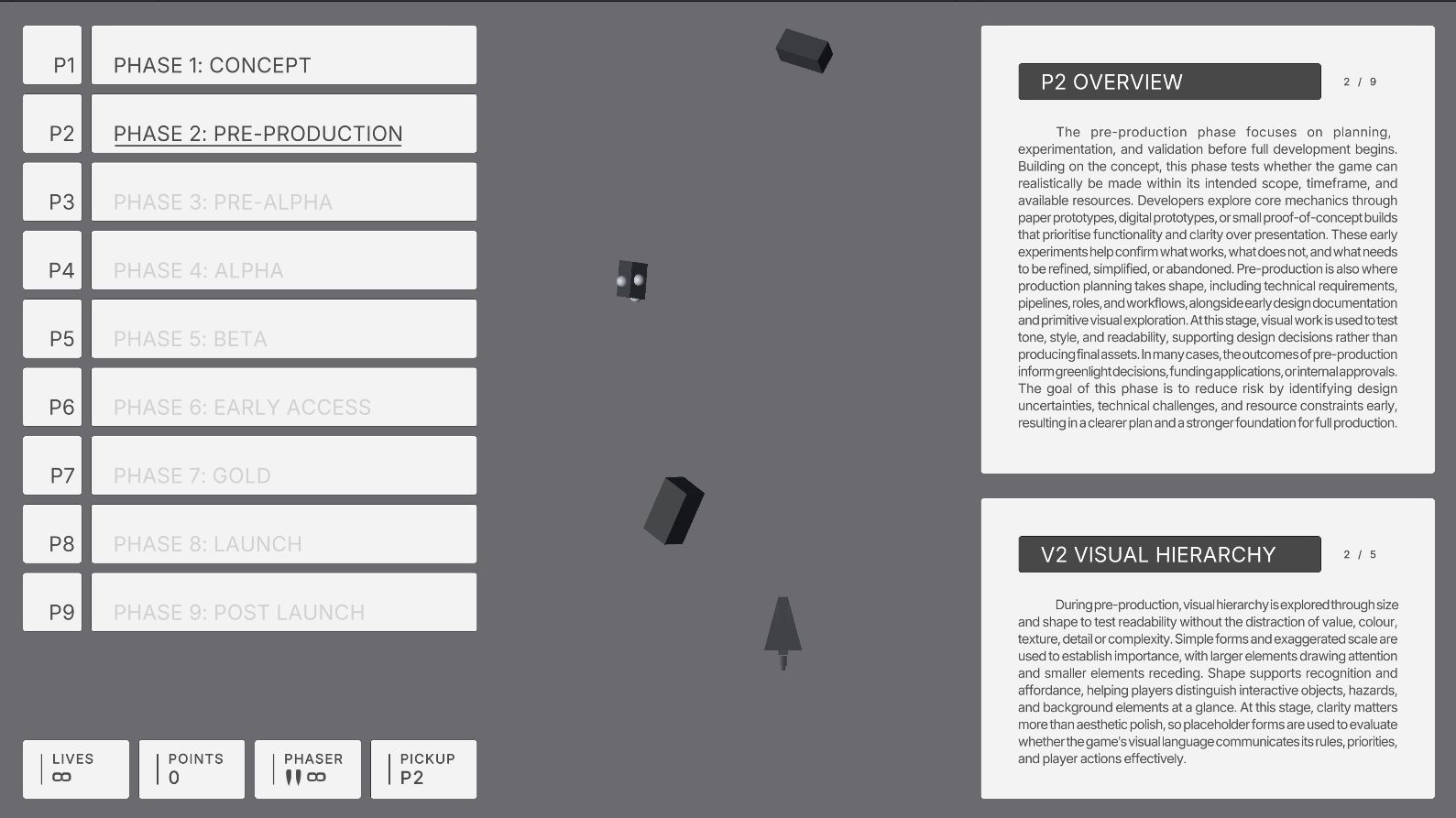
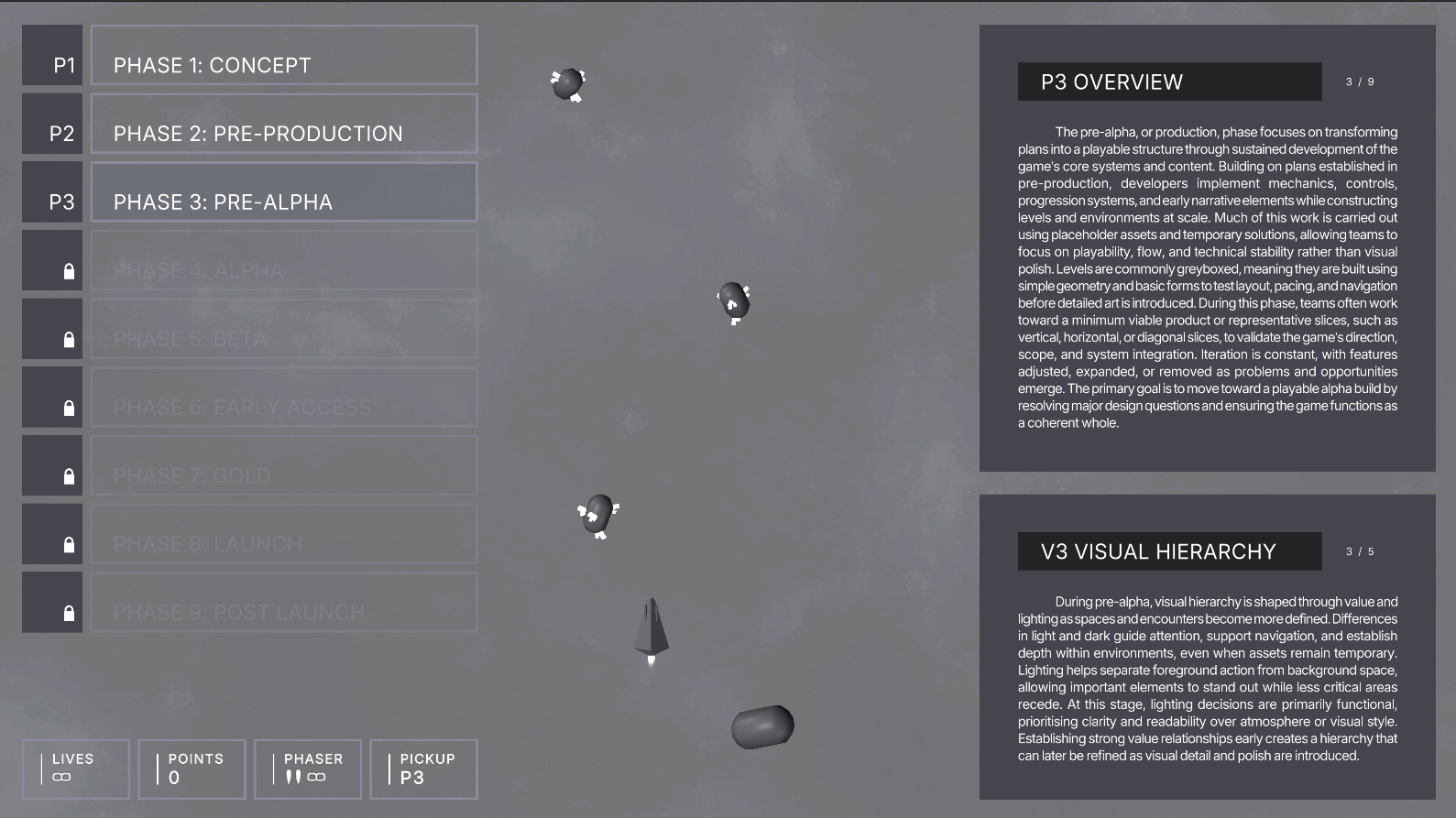
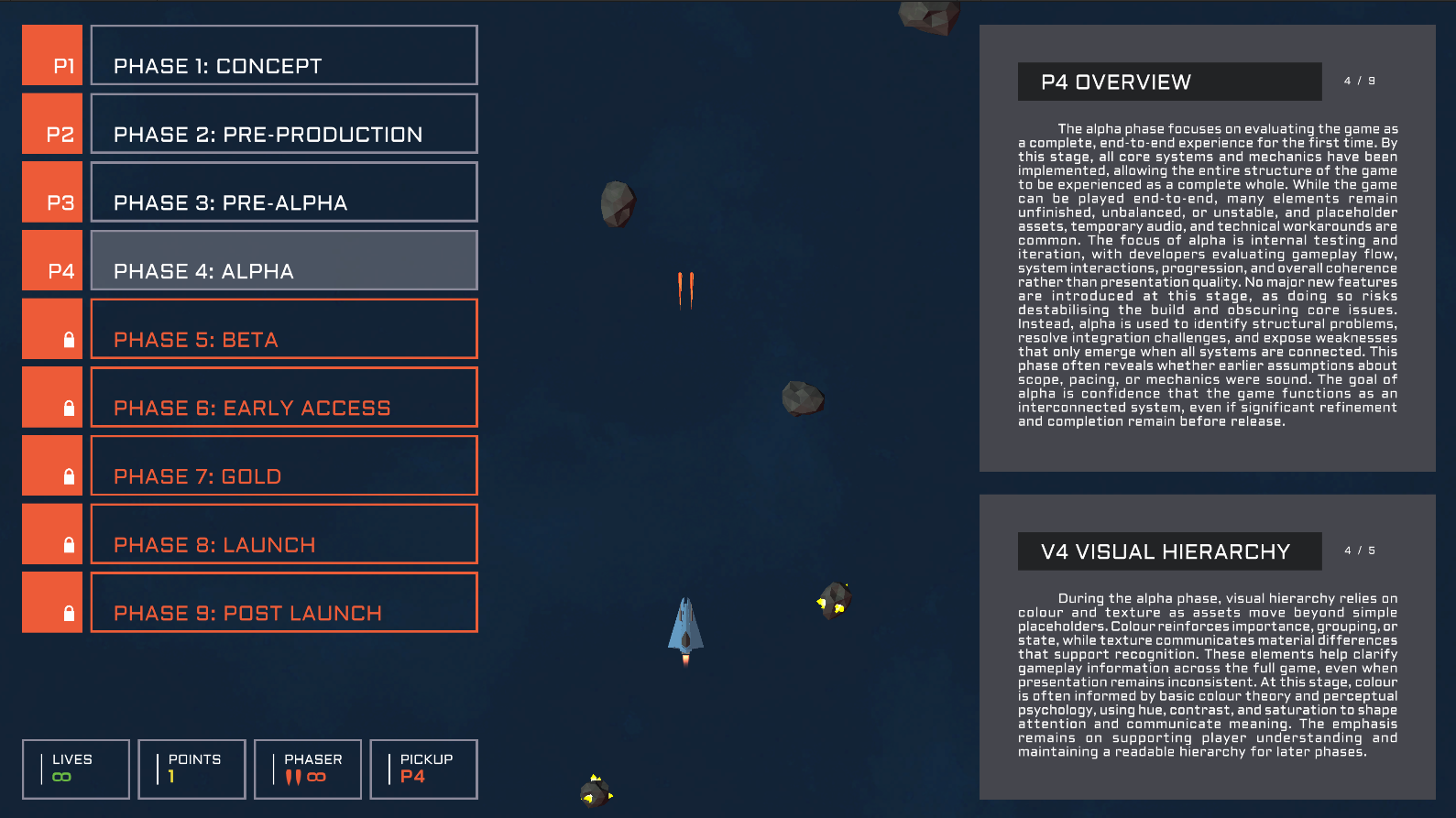
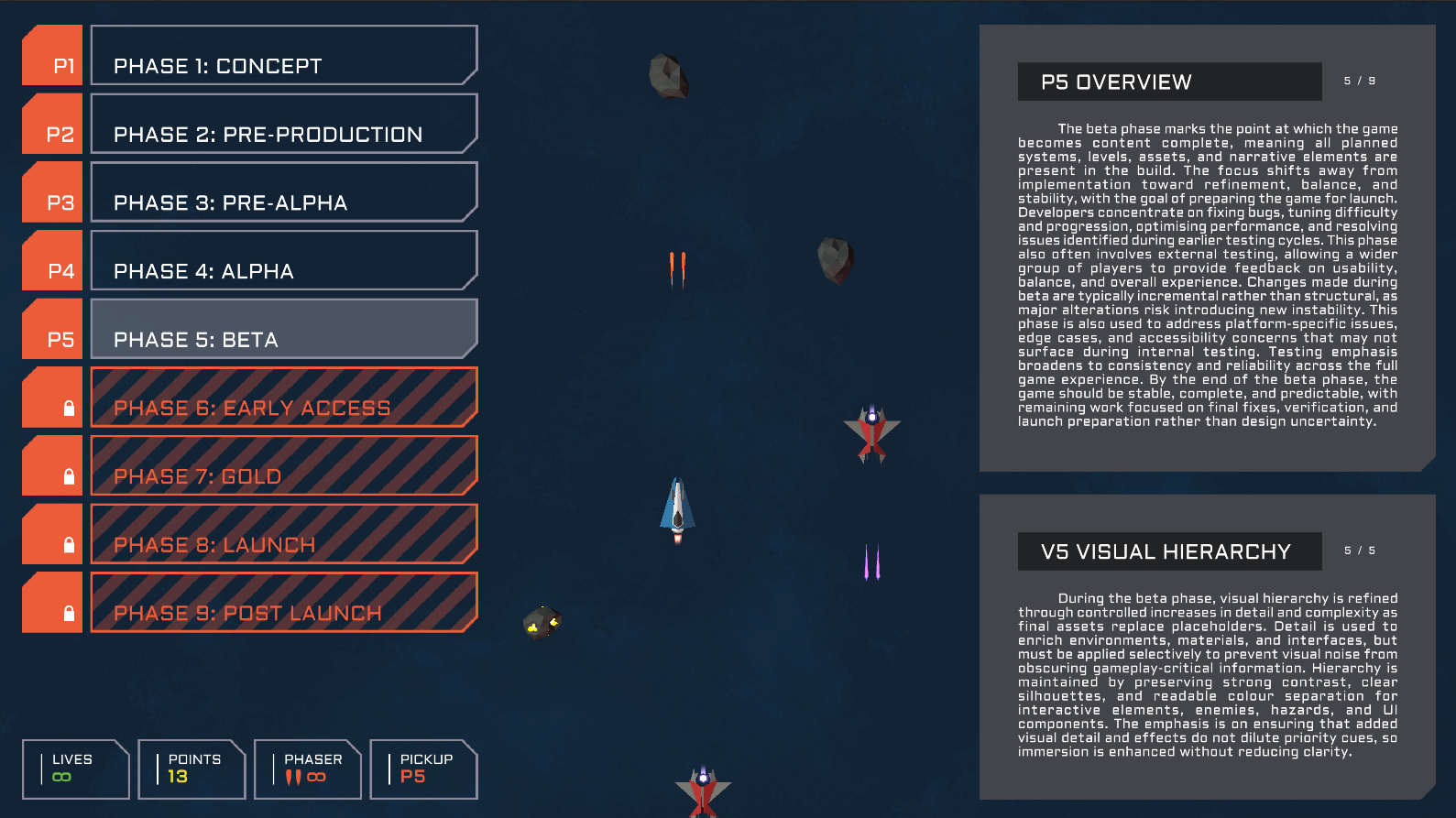
Pipeline Protocol is a space-shooter in which progression is tied to the game production pipeline. As players progress, each pickup unlocks a new stage of development, linking production activities to key production principles alongside theories of visual hierarchy and supporting auxiliary information. Collecting a pickup immediately upgrades the game’s visuals and mechanics, allowing players to experience the impact of pipeline decisions in real-time. Through this structure, Pipeline Protocol functions as a fast, clear, and engaging learning tool, showing how games evolve from greybox foundations to completed releases through play.

Game development pipelines vary significantly across studios, projects, budgets, team sizes, and production cultures. It is important to note that no single protocol can fully represent this diversity. Therefore, this game presents an overarching framework intended to build a foundational understanding. It does not attempt to capture the full nuance, iteration, or complexity of every real-world production, but instead offers a simplified lens for learning and discussion.

Understanding the game production pipeline can be challenging for students new to game development. While industry and educational sources commonly describe development as a sequence of distinct stages, including pre-production, production, alpha, beta, polish, launch, and post-launch, these terms often remain abstract for beginners who lack lived production experience. Students frequently conflate stages or misunderstand their purpose, for example confusing prototype with alpha or assuming polish and gold represent the same point in development. This lack of clarity can undermine their ability to plan effectively, manage scope, and reflect critically on their work.
Although textbooks and industry frameworks provide clear definitions, production pipelines are inherently iterative and layered. This complexity can be difficult to communicate through static instruction alone, particularly when students struggle to connect conceptual terminology with the tangible progression of functionality, assets, and systems within a game. Addressing this challenge requires an approach that moves beyond definition and instead creates opportunities for learners to experience production as an ordered system, without imposing rigid linearity on an iterative process.
Pipeline Protocol emerged in response to this pedagogical gap. The project was originally inspired by conversations with game developer and educator Dr Justin Carter, which explored how visual attention and visual hierarchy shape player experience, readability, and a player’s perception of a game. These discussions highlighted the role of visual hierarchy as a structuring logic that guides attention and establishes order, rather than functioning purely as an aesthetic concern. This insight provided the foundation for exploring how production phases might be communicated through visual change and interaction.
An initial proof of concept for Pipeline Protocol was developed in 2020 to explore this idea at a small scale. The project was later expanded into a full playable prototype in late 2025, allowing for deeper integration of production stages, clearer progression, and a more robust research framing. This expanded version was developed for presentation at the DiGRA

Special Thanks:
- Justin Carter
- DiGRA Australia
Presented at DiGRA Australia 2026

- Joel Bennett [Producer]
- Joel Bennett [Artist]
- Joel Bennett [Programmer]
- Rik Lagarto [Narrative Designer]
- Ryan Venner [Sound Designer]
Development log
- Dev Log 2: Minor Presentation Refinements64 days ago
- Dev Log 1: From an Alpha to Release66 days ago
Leave a comment
Log in with itch.io to leave a comment.